

Models
Claude Fable 5 Release (2026): Anthropic's Most Powerful AI Model Explained
Claude Fable 5 is the first Mythos-class model available to the public. State-of-the-art coding, vision, and knowledge work with new safeguards. Pricing, benchmarks, and what it means.
Claude Fable 5 is the most powerful AI model Anthropic has ever made available to the public. It launched on June 9, 2026, as the first “Mythos-class” model that anyone can use, not just a small group of vetted partners.
Mythos-class is a new tier that sits above Anthropic’s Opus family. The company said Fable 5 is state-of-the-art on nearly every tested benchmark. It shines in software engineering, complex knowledge work, vision tasks, and scientific research. The longer and harder the task, the bigger its lead over earlier Claude models.
But this is not a simple “here is a smarter chatbot” launch. Anthropic built an entire safety layer around the model because it is so capable. For most users, this is invisible. For a small share of queries, it matters a lot.
Last updated: June 9, 2026. Based on Anthropic’s official announcement and early access partner reports. For the full model landscape, see our latest AI models compared hub page.
Quick specs
| Spec | Claude Fable 5 |
|---|---|
| Capability tier | Mythos-class (above Opus) |
| Release date | June 9, 2026 |
| Input pricing | $10 per million tokens |
| Output pricing | $50 per million tokens |
| Safeguards | Cybersecurity, bio/chemistry, distillation classifiers |
| Fallback model | Claude Opus 4.8 (when classifiers trigger) |
| Fallback rate | Under 5% of sessions |
| Availability | Claude API, AWS Bedrock, Claude Platform |
| Subscription access | Free on Pro/Max/Team/Enterprise until June 22 |
| Best for | Long coding tasks, complex analysis, vision work, autonomous agents |
| Watch out for | Conservative safeguards, higher token cost vs Opus |
The Mythos-class tier explained
Anthropic has used a naming system with tiers: Haiku (fast and cheap), Sonnet (balanced), and Opus (most capable). Mythos-class is a new tier above Opus.
The first Mythos-class model, Claude Mythos Preview, shipped in April 2026 through Project Glasswing. Only a small group of cybersecurity defenders and critical infrastructure providers got access. At the time, Anthropic said the models were too dangerous to release publicly because of their cybersecurity capabilities.
Fable 5 changes that. Anthropic spent months building safeguards that can detect and block high-risk queries reliably enough to release the model to everyone. The name “Fable” comes from the Latin fabula, meaning “that which is told.” Anthropic noted it is similar to the Greek mythos, reflecting that both models share the same underlying intelligence.
Claude Mythos 5 launched the same day. It is the exact same model, but with cybersecurity safeguards lifted. It is restricted to Project Glasswing partners for now.
What Fable 5 can actually do
Anthropic’s announcement focused on four areas where Fable 5 shows the biggest gains over previous models.
Software engineering
The standout result came from Stripe. In early testing, Fable 5 performed a codebase-wide migration across a 50-million-line Ruby codebase in a single day. Stripe said the same work would have taken a whole team over two months by hand.
On Cognition’s FrontierCode evaluation, which tests whether models can pass difficult coding tasks while meeting production codebase standards, Fable 5 scored highest among all frontier models at medium effort. It also handles coding tasks with fewer tokens than earlier Claude models, which means lower API costs for the same output.
Cursor put Fable 5 at the top of its CursorBench evaluation. GitHub’s chief product officer called it “a real step forward for the developers GitHub serves.”
Knowledge work and reasoning
On Hebbia’s Finance Benchmark for senior-level reasoning, Fable 5 earned the highest score of any model. It showed major gains in document-based reasoning, chart and table interpretation, and problem solving. IMC, a trading firm, said Fable 5 aced their trading analysis evaluations across the board.
One early access partner summarized the shift: “Fable 5’s reasoning is a clear step beyond Opus 4.8. It works at senior research scientist grade, picking directions, allocating resources, killing its incorrect beliefs, and producing novel first-principles outputs.”
Vision
Fable 5 is the new state-of-the-art model for vision tasks. It can pull precise numbers from detailed scientific figures. It can rebuild a web app’s entire source code from screenshots alone.
Anthropic tested it on Pokémon FireRed, a game that earlier Claude models could not play without extra tooling and game-state helpers. Fable 5 completed the game using only raw screenshots, with no maps, navigation aids, or extra information. That is a before-and-after picture of what vision in AI models can now do.
Memory and long-context handling
Fable 5 stays focused across millions of tokens and improves its outputs using its own notes. When Anthropic had the model play Slay the Spire, a deck-building game, giving it access to persistent file-based memory improved its performance three times more than the same upgrade did for Opus 4.8. Fable 5 also reached the game’s final act three times more often.
This matters for real work. An early partner reported that Fable 5 “reflects on and validates its own work. For us, that’s what makes highly autonomous operations possible, the extra thinking pays for itself.”
Benchmarks: how Fable 5 compares
Anthropic published a comparison table showing Fable 5 and Mythos 5 against other leading models. The key takeaway is that Fable 5 leads or matches the state of the art on nearly every test dimension.
| Area | What the benchmarks say |
|---|---|
| Software engineering | Highest score on FrontierCode among all frontier models at medium effort. Strongest results of any Claude model on agentic coding and prototyping, per early access partners. |
| Finance and reasoning | Highest score of any model on Hebbia’s Finance Benchmark. First model to break 90% on one partner’s core analytics benchmark, a 10-point jump over Opus. |
| Vision | New state of the art. Extracts precise data from scientific figures. Rebuilds web apps from screenshots. Completed Pokémon FireRed with vision alone. |
| Frontier physics | In 36 hours, Fable 5 reached results that took GPT-5.5 four days, using a third of the reasoning tokens. |
| Long-context memory | Stays focused across millions of tokens. Persistent memory improved performance 3x more than Opus 4.8 in game-based tests. |
| Agentic coding | ”State of the art on CursorBench,” per Cursor CEO. “Handles complex multi-agent workflows” per early enterprise partners. |
| Spreadsheets | Beats Opus 4.8 at every effort level, finishing runs 25 to 30 percent faster with fewer turns. |
Anthropic did not publish detailed percentage scores for every benchmark in their announcement. They relied more on customer testimonials and real-world task descriptions. The partner quotes came from teams at Cursor, GitHub, Stripe, Hebbia, IMC, Replit, Lovable, Cognition, and others, all citing their own internal evaluations.
One partner on a vibe-coding benchmark put it plainly: “Apps that took a hundred prompts a year ago, it now one-shots.”

The safeguards: what gets blocked and why
This is the most unusual part of the release. Anthropic built Fable 5 with safeguards that did not exist at this level before.
Fable 5 comes with a set of classifiers, separate AI systems that scan queries for potential misuse. When a classifier detects something risky, the query is not refused. Instead, it gets routed to Claude Opus 4.8, which handles the response.
The classifiers cover three areas:
- Cybersecurity. Fable 5 can find and exploit software vulnerabilities at a level that could make cyberattacks substantially easier and cheaper. The classifiers block queries related to exploitation and offensive cyber tasks. In internal testing, external red-teaming organizations and a bug bounty program with over 1,000 hours of testing found no universal jailbreaks that could bypass these safeguards.

Anthropic also published an internal evaluation showing Fable 5’s jailbreak resistance against automated red-teaming compared to earlier models:

-
Biology and chemistry. Fable 5 can reason about biological problems at a level that could be misused for bioweapons research. For example, it outperformed specialized protein language models at predicting how genetic modifications would affect viral shell assembly, a task relevant to gene therapy but also to designing dangerous viruses. Until Anthropic narrows these classifiers, Fable 5 falls back to Opus 4.8 on most biology and chemistry queries.
-
Distillation. Anthropic has seen large-scale attempts by actors in authoritarian countries to extract or “distill” Claude’s capabilities to train competing models. Queries flagged as part of such attempts fall back to Opus 4.8.
The safeguards are deliberately conservative. Anthropic admits they are stricter than ideal, and sometimes harmless requests will trigger them. The company said this happens in less than 5 percent of sessions on average, and they plan to reduce false positives after launch.
For the 95 percent of sessions where no classifier triggers, Fable 5 performs the same as Mythos 5.
A new data retention policy also applies to Fable 5, Mythos 5, and future models at a similar capability level. Anthropic will retain business customer traffic data for 30 days, strictly for safety purposes like detecting new jailbreaks and reducing false positives. The data will not be used for training.
Claude Mythos 5: the unrestricted sibling
Claude Mythos 5 is the same underlying model, but with cybersecurity safeguards lifted. It is available only to existing Project Glasswing partners, including the US government and a small group of cybersecurity and critical infrastructure organizations.
Anthropic plans to expand access through a broader trusted access program. It also intends to open a separate trusted access program for biology, giving vetted researchers access to Fable 5 with the biology and chemistry classifiers removed.
In internal testing, Mythos 5 accelerated parts of the drug design process by around ten times. When tested on protein design tasks with no human assistance, it matched or beat skilled human operators. It also produced novel molecular biology hypotheses that Anthropic’s scientists preferred over Opus-class models 80 percent of the time in blinded comparisons.
One Mythos hypothesis, a novel mechanism for an E. coli protein, was independently corroborated by a separate lab working on the same problem.
Mythos 5 also conducted a week of largely autonomous genomics research, assembling single-cell data for millions of cells across 138 animal species and designing a custom machine learning model that outperformed a recent publication in the journal Science, despite being 100 times smaller.
Pricing and availability
Both Fable 5 and Mythos 5 cost $10 per million input tokens and $50 per million output tokens. That is less than half the price of Claude Mythos Preview, but double the cost of Claude Opus 4.8 ($5/$25).
Developers can use the model ID claude-fable-5 via the Claude API. If you want to try it without a direct Anthropic contract, check our OpenRouter free models guide for routing options (availability may lag behind the direct API). On Amazon Bedrock, Fable 5 is available in the US East (N. Virginia) and Europe (Stockholm) regions. The Claude Platform on AWS covers North America, South America, Europe, and Asia Pacific.
For subscription plans, the rollout is staged:
- June 9 to June 22: Fable 5 is included at no extra cost on Pro, Max, Team, and seat-based Enterprise plans.
- June 23 onward: Fable 5 moves to a usage credit model on those plans. If capacity allows, Anthropic will extend the free window.
- Later: Anthropic aims to restore Fable 5 as a standard part of subscription plans once sufficient capacity is available.
API and consumption-based Enterprise plans get full access from day one.
Anthropic expects demand to be very high and difficult to predict. The staged subscription rollout is designed to avoid crashing the service, not to extract more money.
Fable 5 vs Opus 4.8: when to switch
If you use Claude regularly, here is the practical question: when should you pay more for Fable 5 instead of staying on Opus 4.8?
| Scenario | Recommendation |
|---|---|
| Long coding tasks (multi-file refactors, agent pipelines) | Use Fable 5. The lead over Opus grows with task complexity. |
| Complex analytical work (legal review, finance, research) | Use Fable 5. Partners report it reasons at a higher level and self-validates its work. |
| Vision-heavy tasks | Use Fable 5. It is the new state of the art for vision. |
| Quick chat, simple queries, cost-sensitive high-volume work | Stay on Opus 4.8. You will get solid results for half the price. |
| Sensitive cybersecurity or biology research | Use Mythos 5 if you have access. Otherwise, accept that Fable 5 will fall back to Opus for those topics. |
| Everyday writing and summarization | Opus 4.8 is still strong. Only switch if you hit quality ceilings. |
The pricing difference is meaningful. At $10/$50 per million tokens, Fable 5 costs exactly double Opus 4.8. If your workload does not need the extra capability, Opus 4.8 is the better value.
Fable 5 vs the rest of the frontier (GPT-5.5, DeepSeek V4 Pro, Gemini 3.1)
Fable 5 does not exist in a vacuum. The Claude Fable 5 vs GPT-5.5 question is the first one most teams will ask, since those two models sit at the top of the coding and reasoning leaderboards. The frontier AI market has three other heavy hitters, and picking between them comes down to your specific stack and priorities.
| Dimension | Claude Fable 5 | GPT-5.5 | DeepSeek V4 Pro | Gemini 3.1 Pro |
|---|---|---|---|---|
| Release date | June 9, 2026 | April 23, 2026 | April 2026 (preview) | March 2026 |
| Input price | $10/M tokens | $15/M tokens | ~$2/M tokens | $10/M tokens |
| Output price | $50/M tokens | $75/M tokens | ~$8/M tokens | $40/M tokens |
| Context window | Not specified | 256K tokens | 1M tokens | 2M tokens |
| Coding | Top on FrontierCode. Strongest Claude ever for agents | Leads SWE-Bench Pro (58.6%). Strong terminal + desktop agents | Strong open-weight coder. 1M context helps big repos | Strong on standard benchmarks. Best inside Google ecosystem |
| Vision | New state of the art | Capable but not highlighted in launch | Good for open-weight tier | Leading multimodal (video, image, audio in) |
| Long-horizon tasks | Best available. Lead grows with complexity | Strong with computer use + browser agents | Good for large-context tasks | Solid but behind on complex agent loops |
| Safeguards | Classifiers block cyber/bio queries. Falls back to Opus 4.8 | Cyber safeguards may refuse some security prompts | Compliance review needed for regulated industries | Standard safety filters |
| Open weights | No | No | Yes | No (Gemma 4 for local) |
| API access | Claude API, AWS Bedrock | OpenAI API, Azure, Codex | DeepSeek API, OpenRouter | Vertex AI, AI Studio, Gemini app |
| Best for | Hard coding tasks, complex analysis, vision work, autonomous agents | Coding agents in OpenAI ecosystem, spreadsheets, computer use | Budget coding, self-hosted deployments, 1M context tasks | Google Workspace users, multimodal apps, long context |
Pick Fable 5 if you are already in the Claude ecosystem and hitting quality ceilings on Opus 4.8. The coding and reasoning jump is real, and the price increase over Opus 4.8 is the cost of that ceiling breaking.
Pick GPT-5.5 if your team lives in OpenAI’s world: Codex, ChatGPT, Azure. The agent stack (terminal, browser, spreadsheets) is better integrated than Anthropic’s equivalent. But you will pay more per token and you get a different philosophical approach to safety.
Pick DeepSeek V4 Pro if cost is your primary concern. At roughly one-fifth the price of Fable 5 for outputs, it is the budget frontier option. The 1M token context window is also larger. But you trade off some raw capability on the hardest tasks, especially long and complex ones. Also check your compliance requirements before using DeepSeek for regulated work.
Pick Gemini 3.1 Pro if your files, email, and docs already live in Google Workspace. The 2M token context window is the largest among these models. Multimodal input (video, image, audio) is stronger than Claude’s offering. But for sustained autonomous coding agents, Fable 5 and GPT-5.5 both pull ahead.
The short version: Fable 5 is the new best for autonomous coding agents and hard analytical work if you can afford the token cost. GPT-5.5 is the safer pick for teams already on OpenAI. DeepSeek V4 Pro is the cost leader. Gemini 3.1 Pro is the Google ecosystem play.
Early reactions from developers and enterprises
The announcement landed on June 9, 2026, so broad community reaction is still developing. What we have so far comes from the early access partners Anthropic quoted in their announcement.
Cursor’s CEO Michael Truell said Fable 5 “opened up a class of long-horizon problems that were out of reach for earlier models.”
GitHub CPO Mario Rodriguez described it as “a real step forward” and pointed to the direction it signals: “a future where developers can hand increasingly ambitious work to agents and trust the results across the software lifecycle.”
Replit reported “the strongest results of any Claude model we’ve had the opportunity to test.”
Lovable noted that Fable 5 “understands what builders mean, not just what they type.” Apps that used to take a hundred prompts a year ago now get built in a single shot.
The legal industry also weighed in. One law firm partner said Fable 5 “feels materially different” and that in blind review, its redlines matched or beat their current model every time.
On the analyst side, Fable 5 “is the first to break 90 percent” on one team’s core analytics benchmark, a 10-point jump over Opus 4.8.
The main concern voiced so far is the conservative safeguards sometimes catching harmless requests. Anthropic acknowledges this and says reducing false positives is a priority.
On Hacker News, the initial discussion thread saw some confusion because the announcement page briefly returned a 404 error before going live properly. A few users noted seeing screenshots of the post on Reddit and Twitter before the official page was accessible, suggesting a coordinated launch with a short embargo break.
What this means for the AI model landscape
Fable 5 changes the frontier. Before this release, the most capable models available to anyone were the Opus-class models (Claude Opus 4.8), GPT-5.5, and DeepSeek V4 Pro (see our DeepSeek V4 vs ChatGPT vs Claude comparison). Fable 5 moves the ceiling up by a meaningful margin, especially for long and complex tasks.
For developers building on Claude, the practical effect is clear: if you are currently running Opus 4.8 and hitting quality limits, Fable 5 is the step up. The API integration path is identical. You change the model ID and you get the new capability ceiling.
For teams using GPT-5.5, the Claude Fable 5 vs GPT-5.5 comparison becomes more interesting. Anthropic’s partner reports claim Fable 5 matched GPT-5.5’s frontier physics research output in 36 hours that took GPT-5.5 four days, using a third of the reasoning tokens. That is one data point from one domain, but it suggests the model gap is real.
For the broader ecosystem, the bigger story is the safety framework. Anthropic released a model it previously said was too dangerous to make public. It did so by building a new layer of AI guardrails that inspect every query before the main model responds. Whether this approach works at scale, and whether other labs copy it, will be one of the defining questions of the next few months.
Who should use, watch, or skip
| Persona | Verdict | Why |
|---|---|---|
| Developer building agent pipelines | Use it | Strongest coding model Anthropic has shipped. Handles long, multi-step tasks with less supervision. |
| Researcher doing deep analysis | Use it | Reasoning at a higher grade than Opus 4.8. Self-validates its own work. |
| Designer or product builder needing vision | Use it | New state of the art for vision tasks. Rebuilds UIs from screenshots. |
| Cost-conscious high-volume user | Watch it | $10/$50 per million tokens is double Opus 4.8. Wait until you hit a quality ceiling. |
| Cybersecurity professional | Apply for Mythos 5 | Fable 5 will fall back to Opus 4.8 on security queries. You need Mythos 5 for unrestricted access. |
| Casual Claude user on a free plan | Skip for now | The free tier does not include Fable 5. Opus 4.8 is more than enough for everyday tasks. |
Changelog
- 2026-06-09: First publish. Claude Fable 5 and Claude Mythos 5 release coverage, benchmarks, pricing, safeguards, and early partner reactions.
Frequently asked
8 questionsWhat is Claude Fable 5?
Claude Fable 5 is Anthropic's newest AI model, released June 9, 2026. It is the first "Mythos-class" model available to the general public, a tier that sits above the company's Opus class in capability. It shares the same underlying model as Claude Mythos 5 but includes safeguards that block responses in high-risk areas like cybersecurity and biology, falling back to Claude Opus 4.8 instead.
How is Claude Fable 5 different from Claude Opus 4.8?
Fable 5 belongs to a higher capability tier called Mythos-class. It leads Opus 4.8 on nearly every benchmark, especially on long and complex tasks. The gap widens as tasks get harder and run longer. Fable 5 also costs more at $10/M input and $50/M output tokens, double Opus 4.8's rates.
How much does Claude Fable 5 cost?
Both Claude Fable 5 and Claude Mythos 5 are priced at $10 per million input tokens and $50 per million output tokens. This is less than half the price of the previous Claude Mythos Preview. For subscription users on Pro, Max, Team, and seat-based Enterprise plans, Fable 5 is included at no extra cost from June 9 through June 22, 2026. After that, it requires usage credits.
What is the difference between Claude Fable 5 and Claude Mythos 5?
Both models share the same underlying brain. The difference is in the safeguards. Fable 5 has classifiers that detect sensitive queries in cybersecurity, biology, chemistry, and model distillation, then fall back to Opus 4.8. Mythos 5 has these safeguards lifted in some areas. Mythos 5 is limited to vetted Project Glasswing partners, while Fable 5 is available to everyone.
Where can I access Claude Fable 5?
You can use Claude Fable 5 through the Claude API (claude-fable-5), Amazon Bedrock (US East N. Virginia and Europe Stockholm regions), and the Claude Platform on AWS. It is also available on Anthropic's own apps for Pro, Max, Team, and Enterprise subscribers.
What are the safeguards on Claude Fable 5?
Fable 5 uses new classifiers, which are separate AI systems that detect potentially harmful queries in three areas: cybersecurity (including offensive cyber tasks and agentic hacking), biology and chemistry (to prevent misuse for bioweapons), and distillation (attempts to extract the model's capabilities to train rival AI). When a classifier triggers, Opus 4.8 handles the response instead. Early data shows more than 95% of Fable sessions involve no fallback at all.
Is Claude Fable 5 good for coding?
Yes. Early testers report strong results. Stripe used Fable 5 to complete a codebase-wide migration across a 50-million-line Ruby codebase in a single day, work that would have taken a team over two months. Cursor placed Fable 5 at the top of its CursorBench evaluation. GitHub called it "a real step forward for the developers GitHub serves."
How do users feel about Claude Fable 5?
The model launched on June 9, 2026, so broad user sentiment is still forming. Early access customers from Stripe, Cursor, GitHub, Hebbia, and other partners have been strongly positive. The main concern raised so far is about the conservative safeguards sometimes blocking harmless requests, though Anthropic says this happens in less than 5% of sessions and they plan to reduce false positives over time.
More in Models
View all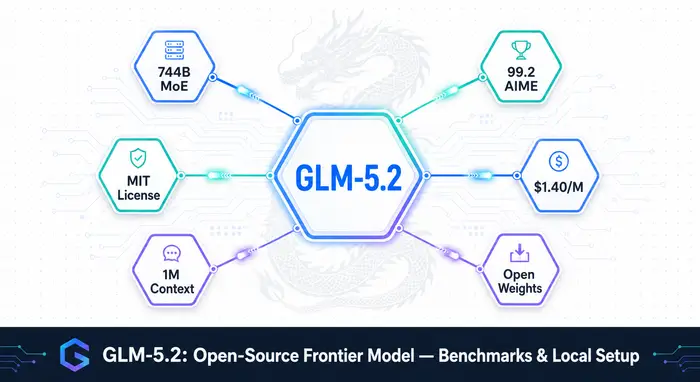
GLM-5.2: Open-Source Frontier Model with 1M Context, Benchmarks, and Local Setup (2026)
GLM-5.2 from Zhipu AI is a 744B open-weight model under MIT license. Benchmarks, pricing, local setup with vLLM and llama.cpp, and how it compares to Claude Opus 4.8 and GPT-5.5.
Models

Kimi K2.7 Code (2026): 1T MoE Coding Model, Benchmarks & Pricing
Kimi K2.7 Code: 1T open-source coding model from Moonshot AI, 32B active MoE, preserve_thinking mode, benchmarks vs GPT-5.5 and Claude Opus.
Models

MiniMax M3 Open Source (2026): 428B Model, 1M Context & Benchmarks
MiniMax M3: 428B open-weights model, 1M context via sparse attention, native multimodal input, competitive coding benchmarks, and 10x cheaper than GPT-5.5.
Models
More stories
View all
US Government Blocks Anthropic Fable 5 & Mythos 5 (2026)
US government ban on Anthropic: Commerce Dept ordered suspension of Fable 5 & Mythos 5 on June 12, 2026. Full timeline of the 4-month feud.
Models

Siri AI Review (2026): Apple's Rebuilt Assistant vs ChatGPT & Gemini [Tested]
Siri AI is Apple's rebuilt assistant for 2026. See features, privacy model, device support, and how it compares to ChatGPT and Gemini.
Review

Ideogram AI Review (2026): Free Tier Tested, vs Midjourney & Recraft
Ideogram AI review (2026): we tested free tier, pricing, text rendering, and Ideogram 4.0 vs Midjourney and Recraft. Who should use it?
Review

Genspark Speakly Review (2026): Pricing, Accuracy & Is It Worth It?
Honest genspark speakly review after hands-on testing. See Speakly pricing, accuracy, free tier limits, and how it compares to Otter and Whisper.
Review