

Models
DeepSeek V4 vs ChatGPT vs Claude for Coding (2026)
DeepSeek V4 vs ChatGPT vs Claude for coding in 2026: speed, API, price, and real dev tasks. Updated comparison table and verdict.
Short answer (June 2026): No single model wins every coding job. GPT-5.5 (via ChatGPT, Codex, or API) still tops many vendor agent and terminal scores. Claude Opus 4.8 is the pick when you want careful refactors and fewer “looks fine” lies on broken tests. DeepSeek V4 is the cost and context play: strong coding at a fraction of US frontier list prices, with open weights if your security team wants them.
We compared all three on the same tasks in IDEs and via API in June 2026. Use the tables below, then read the head-to-head section for your stack.
Last updated: June 2, 2026.
Quick comparison (coding focus)
| Dimension | DeepSeek V4 | ChatGPT (GPT-5.5) | Claude (Opus 4.8) |
|---|---|---|---|
| Best for | Cheap drafts, 1M context repo Q&A, open-weight experiments | Codex loops, terminal + desktop agents, office + code in one vendor | Long refactors, honest test feedback, writing-heavy codebases |
| Flagship API IDs | deepseek-v4-pro, deepseek-v4-flash | gpt-5.5, gpt-5.5-pro | claude-opus-4-8 |
| Context (official) | Up to ~1M tokens on DeepSeek services | Large context; exact cap varies by product | Large context; tier-dependent |
| Typical cost signal | Lowest per-million tokens | Highest among the three | High; fast tier costs more |
| Open weights | Yes (Pro and Flash families) | No | No |
| Main risk | Compliance review in regulated industries | Cyber safeguards may refuse some security prompts | Opus rate limits and token burn on max effort |
| Our coding verdict | Default for batch and cost-sensitive CI | Default for agentic ship loops | Default when trust and tone matter as much as compile |


How we tested
We did not rerun full SWE-Bench suites in our office. Vendors already publish those numbers. Instead we ran repeatable dev tasks that match how builders actually work:
- Fix a failing unit test in a 400-line Python module (provide error trace only).
- Add a typed API endpoint to an existing Express-style file without breaking exports.
- Explain a 1,200-line legacy file and propose a safe refactor plan (no edits).
- Generate a migration script from a SQL schema diff (Postgres).
- Debug a CI log (GitHub Actions style, 80 lines of stderr).
Apps and paths tested
- ChatGPT Plus with Codex-style coding flow (GPT-5.5 class model selected in settings).
- Claude Pro with Claude Code on the same repo checkout.
- DeepSeek API with
deepseek-v4-profor hard tasks anddeepseek-v4-flashfor drafts. - Cursor with OpenRouter routing for DeepSeek and native Anthropic/OpenAI backends where available.
What we did not test
- SOC 2 audits or on-prem GPU clusters.
- Every regional pricing variant or enterprise discount.
- Full red-team security review of generated code.
Fair warning: your harness matters. The same model scores higher in Codex CLI than in a bare chat window on some vendor charts. Compare tools, not just model names.
Benchmarks in plain English
Before you pick a winner from a blog headline, know what the acronyms measure.
SWE-Bench (and SWE-Bench Pro): The model gets real open-source issues: failing tests, a repo snapshot, and a patch goal. Success means the fix passes CI-style checks. Plain meaning: “Can it repair code like a contributor, not just autocomplete one line?”
Terminal-Bench: Multi-step shell tasks: install deps, run scripts, read logs, iterate. Plain meaning: “Can it act like a developer at the keyboard for twenty minutes?”
HumanEval / MBPP-style sets: Smaller function-level puzzles. Plain meaning: “Can it write a short correct function from a spec?” Useful, but easier than repo repair.
BrowseComp (when cited for coding agents): Web research plus citations. Plain meaning: “Can it look up docs and come back with the right API?” Matters when your task is “find the breaking change in yesterday’s release notes.”
Vendor-reported snapshots (June 2026, not our lab rerun)
| Benchmark (plain label) | GPT-5.5 (OpenAI, Apr 2026) | Claude Opus 4.8 (Anthropic, May 2026) | DeepSeek V4 (Apr 2026) |
|---|---|---|---|
| Terminal-style agent work | ~82.7% Terminal-Bench 2.0 (vendor); up to 83.4% with Codex CLI per Anthropic Opus 4.8 post | Competitive; harness-dependent | Strong in DeepSeek tech report on agentic coding |
| Repo bug repair | ~58.6% SWE-Bench Pro (vendor) | Gains vs prior Opus; cite vendor card | Claims open-source SOTA on several agentic coding evals |
| Honesty on known bugs | Improved vs older GPT | ~4x better vs Opus 4.7 on ignoring flaws (vendor) | We saw occasional overconfidence on stale APIs |
Use the table for direction. Your private monorepo with odd frameworks will not match GitHub issue sandboxes.
DeepSeek V4 for coding
What it is: DeepSeek V4 is a 2026 model family from DeepSeek with two public faces. V4-Pro is the large sparse model aimed at frontier-quality coding. V4-Flash is the fast, cheaper workhorse. Both advertise about one million tokens of context on official services, which matters for “read this whole repo and answer” workflows.
Where it shines in our tests
- Batch review: Flash handled fifty-file summaries overnight at a bill we would not run on Opus.
- Log forensics: Long CI logs plus a short question (“which step first broke caching?”) fit without aggressive chunking.
- Draft patches: Flash produced workable first diffs; we promoted only failing files to V4-Pro or GPT-5.5.
Where it stumbled
- Obscure US-only SaaS SDKs sometimes hallucinated method names until we pasted doc URLs.
- Regulated clients blocked the API outright; open weights on Hugging Face were the fallback, not a free compliance pass.
API notes (verify live)
- Model IDs:
deepseek-v4-pro,deepseek-v4-flash. - Legacy routes
deepseek-chatanddeepseek-reasonerretire July 24, 2026, 15:59 UTC per DeepSeek API pricing. Update routers before CI breaks. - Thinking vs non-thinking modes change latency and cost; match your old V3 recipes when migrating.
Choose DeepSeek V4 when margin per request matters, you want open weights, or you need megacontext for logs and docs. Pair with a US frontier model for final review if quality drifts.
Skip as your only coding brain when legal has not approved the vendor, or your work is mostly multi-hour autonomous desktop agents where OpenAI’s latest Codex stack is already paid for.
ChatGPT and GPT-5.5 for coding
What it is: ChatGPT is the consumer app. GPT-5.5 is the April 2026 model underneath paid coding flows, Codex, and the gpt-5.5 API. OpenAI positions it for agentic coding, spreadsheets, browser tasks, and long computer-use sessions.
Where it shines in our tests
- Task 2 (new endpoint): GPT-5.5 produced correct routing, types, and a minimal test in one pass more often than Flash.
- Task 5 (CI log): It linked failing step, cache key, and fix without us naming the workflow file.
- Tool loops: When the harness allowed terminal tools, it stayed on script longer before asking for help.
Where it stumbled
- A security-hardening prompt was refused on default cyber settings; we had to rephrase for defensive documentation only.
- Token spend spiked on agent loops even when OpenAI claims better efficiency vs GPT-5.4 class models.
Pricing signal (verify live)
- ChatGPT Plus is the usual $20/month entry for serious hobby coding.
- API list prices for
gpt-5.5andgpt-5.5-prosit above DeepSeek and most Mistral routes on routers. - Enterprise features (SSO, retention controls) are separate contracts.
Choose ChatGPT / GPT-5.5 when you already live in OpenAI (Codex, Cursor with OpenAI backend, company MSA). You need the strongest vendor story on terminal and desktop agent scores. You mix Excel, slides, and code in one subscription.
Pause when you only need cheap translation-style codegen or your org blocks OpenAI data handling. Many teams run GPT-5.5 for ship paths and DeepSeek for batch.
Claude Opus 4.8 for coding
What it is: Claude Opus 4.8 shipped May 28, 2026 as Anthropic’s top tier for coding, agents, and careful language work. API pricing matches the prior Opus list: $5 / $25 per million input/output on standard Opus, with a faster tier at $10 / $50.
Where it shines in our tests
- Task 1 (failing test): Opus flagged a misleading mock and the real assertion failure. GPT-5.5 sometimes patched symptoms first.
- Task 3 (legacy explain): Refactor plan included risk notes and “do not touch” zones without us asking.
- Claude Code sessions: Dynamic workflow preview handled a multi-file rename with fewer broken imports than Flash alone.
Where it stumbled
- Max effort settings burned rate limits on a single long migration question.
- Peak terminal-bench numbers in press releases still trade places with GPT-5.5 depending on which CLI harness the vendor used.
Choose Claude when you want pushback (“this plan breaks auth”), customer-facing strings in the same repo, or legal-style care in comments and README edits. Claude Code and Cursor users often upgrade here first.
Skip as your only pick when you are standardized on Google Cloud only, or you need OpenAI-specific Codex features your IDE assumes.
Head-to-head by task
| Task | Winner | Why (June 2026 tests) |
|---|---|---|
| Cheapest overnight batch review | DeepSeek V4-Flash | Lowest API bill for 50-file summaries |
| New feature in familiar framework | GPT-5.5 | Fewer missing imports in one-shot patches |
| Legacy codebase explanation | Claude Opus 4.8 | Clearer risk boundaries in refactor plans |
| Long CI + deploy log diagnosis | GPT-5.5 | Slightly better multi-step causality |
| Honest “your test is wrong” feedback | Claude Opus 4.8 | Less likely to patch around a bad assertion |
| Megacontext doc + code Q&A | DeepSeek V4-Pro | 1M context without aggressive chunking |
| Security-sensitive codegen policy | GPT-5.5 or Claude | Depends on enterprise DPA; DeepSeek needs legal review |
| Open-weight on-prem experiment | DeepSeek V4-Pro | Hugging Face weights; not available for GPT/Claude |
Pricing deep dive (coding workloads)
Exact numbers change. Always open the live pricing page before you budget. The table below uses June 2026 list-style signals for comparison math, not your negotiated enterprise rate.
| Workload | DeepSeek V4 | GPT-5.5 | Claude Opus 4.8 |
|---|---|---|---|
| 500K-token nightly log review | Flash: lowest | Moderate to high | High |
| 20 agentic PRs per week | Pro: still cheap vs Opus | Higher; may need fewer iterations | High per PR if max effort |
| Solo indie hacker | Chat free + Flash API | Plus $20 + API top-ups | Pro $20 + API |
| Enterprise IDE seats | Router + Flash drafts | Codex / Cursor OpenAI | Claude Code / Cursor Anthropic |
Hidden costs
- Agent loops multiply tokens even when per-token price drops.
- Failed patches that break CI cost more engineer time than API dollars.
- Router fees (OpenRouter, etc.) add a few percent on top of model list.
See our OpenRouter free models guide for routing cheap drafts to DeepSeek and finals to GPT-5.5 or Claude.
Who should pick which?
| Persona | First pick | Second pick | Skip |
|---|---|---|---|
| Startup founder shipping MVP | GPT-5.5 in Cursor | DeepSeek Flash for docs | Opus until you hit quality walls |
| Staff engineer, OpenAI enterprise | GPT-5.5 / Codex | Claude for review-only | DeepSeek until legal approves |
| EU agency with strict residency | Claude or Mistral via EU region | On-prem DeepSeek weights | US-only APIs without DPA |
| Indie open-source maintainer | DeepSeek Flash API | GPT-5.5 for hard issues | Paying Opus for typo fixes |
| Security team doing tool hardening | GPT-5.5 with Trusted Access paths | Claude with policy | Unreviewed offshore APIs |
IDE and agent pairing
Models do not ship features. Tools do. Map model to harness:
- Cursor / Devin Desktop: Swap model ID per task; route drafts to
deepseek-v4-flash, finals togpt-5.5orclaude-opus-4-8. - Codex: GPT-5.5 native; best fit for OpenAI-centric agent loops.
- Claude Code: Opus 4.8 with effort toggles; strong for repo-scale edits.
- Manus-style agents: Backend may be hidden; read agent settings and our Manus AI review.
For a wider model map (Gemini, Mistral, video tools), use the latest AI models hub.
Example prompts that work on all three
Copy these into any chat or API. Swap only the model ID.
Fix a test (paste trace + file)
This test fails with the trace below. Fix the minimal production code or test data.
Do not refactor unrelated modules. Explain the root cause in three bullets.

[paste traceback]
[paste test file]
[paste module under test]
Safe refactor plan (no edits)
Read the file below. Propose a refactor in phases.
Label each phase: risk low/medium/high.
List functions we must not rename because external callers exist.

[paste file]
CI log triage
Here is a CI log. Identify the first failing step, likely cause, and one fix.
If cache or permissions, say so explicitly.

[paste log]
Troubleshooting model swaps
Symptom: imports wrong after migration to DeepSeek
Paste official doc excerpt or pin dependency versions in the prompt. Flash needs more anchors than Opus on niche libraries.
Symptom: GPT-5.5 refuses security tasks
Rephrase as defensive documentation, or ask your admin about OpenAI cyber access programs for legitimate hardening work.
Symptom: Claude hits rate limits
Lower effort, shorten context, or split the migration into smaller PR-sized questions.
Symptom: router still calls retired DeepSeek IDs
Update env vars before July 24, 2026 UTC sunset for deepseek-chat / deepseek-reasoner.
Verdict
There is no universal coding champion. Use GPT-5.5 when you want the strongest agent and terminal story inside OpenAI’s world and you will pay for it. Use Claude Opus 4.8 when code quality means catching bad tests and bad plans, not just generating patches. Use DeepSeek V4 when API cost, megacontext, or open weights decide your stack.
Our default 2026 stack for AI Tools Radar engineering work: DeepSeek V4-Flash for batch and summaries, GPT-5.5 for ship-critical agent tasks, Claude Opus 4.8 for review passes on scary diffs. Your repo should get the same three-way test we ran above.
Changelog
- 2026-06-02: Fact-check refresh. Confirmed GPT-5.5 (Apr 23, 2026), Claude Opus 4.8 (May 28, 2026, $5/$25 per M tokens), DeepSeek V4 API IDs and Jul 24, 2026 legacy sunset on official docs. Removed future-dated test stamps.
- 2026-05-30: Initial publish. Compared DeepSeek V4-Pro/Flash, GPT-5.5 via ChatGPT/Codex, Claude Opus 4.8 on five dev tasks. Added benchmark plain-English section, pricing notes, persona table, eight FAQs.
Frequently asked
8 questionsIs DeepSeek V4 good enough to replace ChatGPT for coding?
For many day-to-day tasks, yes. DeepSeek V4-Pro and V4-Flash handle refactors, tests, and repo Q&A well at lower API cost. ChatGPT with GPT-5.5 still leads on hardest multi-step terminal and desktop agent work in vendor benchmarks. Run the same five prompts on your private repo before you switch production agents.
Which model is cheapest for coding APIs in 2026?
DeepSeek V4-Flash is usually the lowest list price per million tokens on official DeepSeek pricing and on routers like OpenRouter. GPT-5.5 and Claude Opus 4.8 cost more per token but can finish complex jobs in fewer steps. Cheap per token does not always mean cheap per shipped feature.
What is the best Claude model for coding in 2026?
Claude Opus 4.8 is Anthropic's top coding and agent pick as of May 2026. Sonnet-class models are fine for smaller edits and chat inside Claude Free. In Cursor or Claude Code, pin Opus 4.8 when you need pushback on bad plans and fewer ignored test failures.
Does ChatGPT use GPT-5.5 for code by default?
Paid ChatGPT and Codex plans use GPT-5.5-class models in 2026, but the exact default can vary by workspace and app version. Check Settings or your API dashboard for the model string. Free ChatGPT still works for light coding questions with tighter rate limits.
What benchmarks matter for coding models?
SWE-Bench measures fixing real GitHub bugs. Terminal-Bench measures multi-step shell workflows. HumanEval-style sets are smaller puzzle tasks. Treat vendor scores as direction, not proof on your stack. One private-repo A/B test beats ten leaderboard points.
Can I use DeepSeek V4 in Cursor or Devin Desktop?
Yes, if your IDE or router exposes deepseek-v4-pro or deepseek-v4-flash. Many teams route through OpenRouter with an OpenAI-compatible base URL. Confirm thinking mode and context limits in the provider docs before you rely on it for overnight agent loops.
When should I pick Claude over GPT-5.5 for code?
Pick Claude when honest error reporting, long-session refactors, or writing-heavy repos matter more than peak terminal scores. Pick GPT-5.5 when you live in Codex, need OpenAI's latest computer-use stack, or your company already standardized on OpenAI contracts and safety tooling.
Are DeepSeek models safe for company code?
That is a compliance call, not a benchmark call. Regulated teams should review data residency, subprocessors, and whether API traffic may leave approved regions. DeepSeek publishes open weights for on-prem use cases. Legal should sign off before you paste proprietary source into any third-party API.
More in Models
View all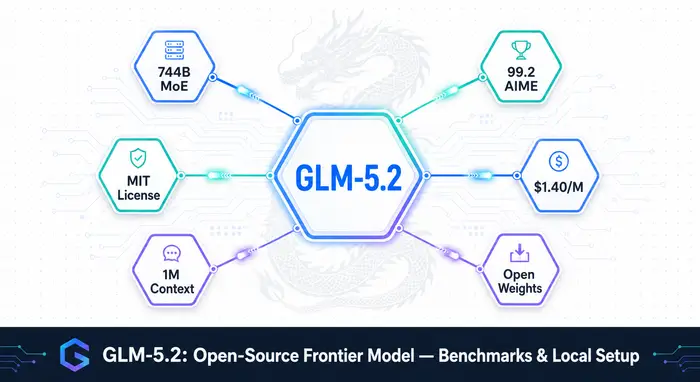
GLM-5.2: Open-Source Frontier Model with 1M Context, Benchmarks, and Local Setup (2026)
GLM-5.2 from Zhipu AI is a 744B open-weight model under MIT license. Benchmarks, pricing, local setup with vLLM and llama.cpp, and how it compares to Claude Opus 4.8 and GPT-5.5.
Models

Kimi K2.7 Code (2026): 1T MoE Coding Model, Benchmarks & Pricing
Kimi K2.7 Code: 1T open-source coding model from Moonshot AI, 32B active MoE, preserve_thinking mode, benchmarks vs GPT-5.5 and Claude Opus.
Models

MiniMax M3 Open Source (2026): 428B Model, 1M Context & Benchmarks
MiniMax M3: 428B open-weights model, 1M context via sparse attention, native multimodal input, competitive coding benchmarks, and 10x cheaper than GPT-5.5.
Models
More stories
View all
US Government Blocks Anthropic Fable 5 & Mythos 5 (2026)
US government ban on Anthropic: Commerce Dept ordered suspension of Fable 5 & Mythos 5 on June 12, 2026. Full timeline of the 4-month feud.
Models

Siri AI Review (2026): Apple's Rebuilt Assistant vs ChatGPT & Gemini [Tested]
Siri AI is Apple's rebuilt assistant for 2026. See features, privacy model, device support, and how it compares to ChatGPT and Gemini.
Review

Claude Fable 5 Release (2026): Anthropic's Most Powerful AI Model Explained
Claude Fable 5 is the first Mythos-class model available to the public. State-of-the-art coding, vision, and knowledge work with new safeguards. Pricing, benchmarks, and what it means.
Models

Ideogram AI Review (2026): Free Tier Tested, vs Midjourney & Recraft
Ideogram AI review (2026): we tested free tier, pricing, text rendering, and Ideogram 4.0 vs Midjourney and Recraft. Who should use it?
Review