

Models
Best AI Models 2026: GPT-5.5 vs Claude vs DeepSeek vs Gemini [Ranked]
Which AI model is best in June 2026? We compared GPT-5.5, Claude Opus 4.8, DeepSeek V4, Gemini 3, and Mistral on coding, writing, and price. Updated ranking inside.
Short answer (June 2026): There is no one “best” AI for everything. The leaders split by job.
GPT-5.5 is the go-to for coding agents, terminal work, and office tasks inside OpenAI’s world. Claude Opus 4.8 is the upgrade for careful writing and teams that already trust Anthropic. Gemini 3.x fits best when your files and email already live in Google. DeepSeek V4 and MiMo V2.5 Pro are the low-cost, open-weight lane for coding experiments and big context. MiMo V2.5 is the cheap multimodal option for video, image, and audio understanding. MiniMax M3 is the new challenger that combines 1M context, multimodal input, and coding scores near frontier levels at a fraction of the price. GLM-5.1 and Kimi K2.6 lead for bilingual coding and long-document work. Qwen 3.6 is the best open-weight coder you can run on a single 24 GB GPU. Gemma 4 31B is the strongest local option for math and multimodal breadth. Mistral matters for EU-friendly hosting and fast API swaps.
Use the table below. Then jump to the section that matches your job.
Last updated: June 13, 2026. This URL is a living hub, not a one-time list.
Living comparison table
| Model | Vendor | Best for (practical) | API / access signal | Watch out for |
|---|---|---|---|---|
| GPT-5.5 | OpenAI | Coding agents, spreadsheets, multi-step computer use | ChatGPT Plus+, Codex, API (gpt-5.5) | Cyber safeguards may refuse some security prompts; enterprise rollout varies |
| GPT-5.5 Pro | OpenAI | Hard research, legal-style depth, BrowseComp-heavy tasks | Pro / Business / Enterprise | Higher cost tier; not always default in apps |
| Claude Opus 4.8 | Anthropic | Writing, analysis, browser agents, honest error flagging | Claude apps, API (claude-opus-4-8), Claude Code | Opus pricing; high effort uses more tokens |
| Gemini 3 Pro / 3.1 Pro | Workspace, multimodal learning, Search AI Mode | Gemini app, Vertex AI, AI Studio | SKU names change in admin console | |
| DeepSeek V4-Pro | DeepSeek | Coding agents, 1M context, open weights | deepseek-v4-pro, Expert mode on chat | Compliance review in regulated industries |
| DeepSeek V4-Flash | DeepSeek | Fast cheap coding drafts | deepseek-v4-flash, Instant mode | Not identical to Pro on hardest agent evals |
| Mistral (Large / Codestral frontier) | Mistral | EU data residency options, router-friendly APIs | Mistral API, partners, OpenRouter | Many similarly named models; pin exact ID |
| MiniMax M3 | MiniMax | Coding agents, 1M context, multimodal (text, image, video in), open weights | MiniMax API, OpenRouter (minimax/minimax-m3), HF weights | 512K guaranteed context; MSA sparse attention; verify tool calling on your stack |
| Gemini 3.5 Flash | Near-Pro coding at Flash cost and speed, multimodal | Gemini app, Vertex AI, AI Studio | Defaults to medium thinking; check SKU names in admin console | |
| Moonshot Kimi K2.7 Code | Moonshot AI | Premium open-weight coding: 1T MoE, 32B active, preserve_thinking | Moonshot API, OpenRouter (moonshotai/kimi-k2.7-code), HF weights | Forced thinking mode; 256K context; $0.95/$4.00 per M tokens |
| Moonshot Kimi K2.6 | Moonshot AI | Long-horizon docs, multimodal, coding drafts (now superseded by K2.7 Code) | Moonshot API, OpenRouter (moonshotai/kimi-k2.6) | Lost :free tag; use K2.7 Code for premium or Qwen3-Coder for free |
| Zhipu GLM-5.1 | Zhipu AI | Coding, agentic tasks, Claude Code compatible | Zhipu API, OpenRouter, Alibaba Cloud | Commercial-use restrictions on weights; strong LMArena Code Arena scores |
| Stepfun Step 3.7 | Stepfun | Multimodal reasoning, terminal agents, auto cockpit | Stepfun API, OpenRouter (stepfun/step-3.7-flash) | 256K context; strong on Chinese-language tasks and embodied AI |
| NVIDIA Nemotron 3 Ultra | NVIDIA | Safety checks, orchestration, agent-style tasks at 1M context | NVIDIA API, OpenRouter (nvidia/nemotron-3-ultra-550b-a55b) | 550B total params; free :free routes on OpenRouter; check latency |
| MiMo V2.5 | Xiaomi | Native multimodal (text, image, video, audio), 1M context, open weights | Xiaomi API, OpenRouter, Hugging Face | 310B/15B MoE; matches Gemini 3 Pro on video tasks |
| MiMo V2.5 Pro | Xiaomi | Agentic coding, long-horizon tasks, 1M context, open weights | Xiaomi API, OpenRouter | 1T/42B MoE; SWE-Bench Pro 57.2%; 40-60% fewer tokens than rivals |
| Qwen 3.6-27B / 35B-A3B | Alibaba | Best open-weight coding, agentic tasks, runs on single GPU | HF Qwen/Qwen3.6-27B, Ollama, vLLM | Apache 2.0; 35B-A3B fits 24 GB VRAM; 256K context |
| Gemma 4 31B | Google DeepMind | Local multimodal (text, image, audio), math, 256K context | HF google/gemma-4-31b-it, Ollama gemma4:31b | Needs 24 GB VRAM for 4-bit; not the coding leader vs Qwen 3.6 |
| Gemma 4 12B Unified | Google DeepMind | Lightweight local multimodal, 16 GB laptop deploy, Apache 2.0 | HF google/gemma-4-12B-it, Ollama gemma4:12b, LiteRT-LM | KV cache VRAM spikes; Ollama 12b tag is text+image only; see Gemma 4 12B guide |
How to read benchmark talk elsewhere: Vendors love percentage scores on named tests. Here is what a few of them mean in plain English.
- Terminal-Bench: Can the model run real command-line tasks step by step?
- SWE-Bench: Can it fix real bugs in open-source GitHub projects?
- GDPval: How well does it do mixed office-style knowledge work?
- BrowseComp: How well does it research the web and cite what it found?
A higher score usually means the model finished more of the test. Treat numbers as a hint, not a single IQ score. Always test on your own work.
How we score this page
AI Tools Radar is not a lab that reruns every vendor leaderboard. We read release posts, system cards, and pricing pages. Then we translate them into language for people who pick a model and a tool.
What we include
- Frontier models that power tools in our three lanes: agents, creators or slides, builders.
- Plain explainers for benchmark names only when the vendor published them for that model.
- Links to deeper AI Tools Radar reviews and weekly radar posts so you can choose tool plus model in one visit.
What we skip
- Giant model lists with no task mapping.
- Calling one model “best” without naming the job.
- Full video-model shootouts (those live in radar posts).
When we refresh: Big releases (GPT-5.5 in April 2026, Claude Opus 4.8 in May 2026, DeepSeek V4 in April 2026, MiniMax M3 in June 2026) or rising search interest on latest ai models 2026.
GPT-5.5 (OpenAI)
What it is in plain English: GPT-5.5 is OpenAI’s newest general-purpose brain, tuned for work that spans many steps. It is meant to read messy instructions, make a plan, use tools (terminal, browser, spreadsheets), check its own output, and keep going. Think “digital coworker,” not “chat box that answers one question.”
OpenAI announced it on April 23, 2026. API access followed on April 24.
Scores vendors cite (April 2026): OpenAI says GPT-5.5 beats its prior version on coding and desktop tasks. Examples from their post:
- Terminal-Bench 2.0 at 82.7%: Better at multi-step terminal work than GPT-5.4 (75.1%). Plain meaning: it follows shell workflows more often.
- SWE-Bench Pro at 58.6%: Fixes more real GitHub issues. Plain meaning: stronger repo repair.
- GDPval at 84.9% wins or ties: Holds up on mixed professional tasks. Plain meaning: decent across job types, not just code.
- OSWorld-Verified at 78.7%: Operates a simulated desktop more reliably. Plain meaning: UI clicking and app control improved.
- BrowseComp at 84.4% (90.1% on GPT-5.5 Pro): Web research with citations. Plain meaning: better for deep lookup tasks.
OpenAI also prints side-by-side rows vs Claude Opus 4.7 and Gemini 3.1 Pro. Use those for trend direction. They are not our independent retest.
What that means day to day: If you want one model to run terminals, patch repos, build slides or sheets, and drive UIs, GPT-5.5 is aimed at you. OpenAI claims GPT-5.4-class speed with fewer tokens on Codex jobs. That matters when you pay per million tokens.
Where you feel it
- ChatGPT (Plus and up): Harder “thinking” style answers for professional work.
- Codex: Build, refactor, debug, and validate code in a loop.
- API: Partners ship
gpt-5.5andgpt-5.5-prowith safety rules at scale.
Choose GPT-5.5 when you already standardize on OpenAI. Your team lives in Codex or Cursor with OpenAI backends. You need computer use plus office files in one loop.
Pause or pair when legal needs another vendor. You only need cheap translation at scale. You want Anthropic-style pushback on bad plans. Many teams run GPT-5.5 for code and Claude for prose.
Safety note: OpenAI rates cyber and bio risk for this generation. Stricter cyber filters may refuse some security prompts. Defenders can apply for Trusted Access for Cyber if refusals block legit hardening work.
Claude Opus 4.8 (Anthropic)
What it is in plain English: Claude Opus 4.8 is Anthropic’s top-tier model for careful language work and long agent sessions. It is built to write well, reason through documents, use a browser when needed, and flag its own mistakes instead of glossing over them.
Anthropic released it on May 28, 2026. API list price matches Opus 4.7: $5 per million input tokens, $25 per million output tokens. A faster tier runs $10 / $50 per million. The pitch is trust and throughput, not a price war.
Scores and claims (vendor-reported): Anthropic’s system card cites gains on coding, agents, reasoning, and knowledge work. Third-party quotes in the launch mention Online-Mind2Web at 84% (plain meaning: better at browsing and acting on web pages) and legal-agent benchmarks. On Terminal-Bench 2.1, Anthropic notes GPT-5.5 at 83.4% with Codex CLI vs its own harness. Harness choice moves scores. Compare models with the same test setup when you can.
Behavior users notice
- Honesty: Opus 4.8 is far less likely to ignore known code flaws (vendor evals cite roughly 4x improvement vs Opus 4.7 on that failure mode).
- Effort control: Turn effort up or down in Claude.ai and Cowork. More depth costs speed and rate limits.
- Dynamic workflows (Claude Code): Research preview for large migrations with parallel subagents. Aimed at repo-scale changes with tests as the bar.
- Fast mode: 2.5x speed at the fast price tier, now cheaper vs prior Opus fast modes.
Choose Claude Opus 4.8 when long reports, legal or finance docs, customer-facing writing, or agents that must push back on weak instructions matter. Teams on Claude Code, Cursor, Devin, or Cowork often upgrade here first.

Pair Claude with tools, not instead of them: Claude does not replace SlideAI, Gamma, or Dokie for deck layout. It supplies words and structure. Presentation tools supply pixels. See our SlideAI review for that split.
Fable 5 and Mythos 5 note (June 12): The US Commerce Department ordered Anthropic to suspend foreign access to its most advanced Fable 5 and Mythos 5 models. Opus 4.8, Sonnet, and Haiku are unaffected. For the full story and what to use instead, see our US Government ban breakdown.
Skip as your only frontier pick when you are all-in on Google Workspace intelligence. You need OpenAI-specific Codex features your IDE assumes.
Gemini 3.x (Google)
What it is in plain English: Gemini 3 is Google’s main AI family for consumers and cloud. It is strong where Google already owns your data: Gmail, Docs, Drive, Search, and Vertex AI. It also handles images, video, and long PDFs well in many plans.
The Gemini 3 generation started rolling out in November 2025. By June 2026, many tables (including OpenAI’s April comparisons) cite Gemini 3.1 Pro as the peer model. Google ships updates inside the 3.x line faster than the major version number changes.

Scores from Google DeepMind (Gemini 3 launch materials):
- LMArena Elo 1501: Crowd-ranked chat quality in vendor reporting. Plain meaning: users preferred it in blind tests on that leaderboard.
- Humanity’s Last Exam 37.5% (no tools): Hard multi-subject exam. Plain meaning: strong broad knowledge, still not perfect.
- GPQA Diamond 91.9%: Graduate-level science Q&A. Plain meaning: very strong on technical Q&A.
- MMMU-Pro 81% / Video-MMMU 87.6%: Image and video understanding tests. Plain meaning: good at reading visuals, not the same as generating Hollywood video.
- SWE-bench Verified 76.2% / Terminal-Bench 2.0 54.2%: Coding and terminal scores in Google’s developer post. Plain meaning: solid coder, not always the terminal leader vs OpenAI.
- WebDev Arena: Google claims leadership for “vibe coding” UIs. Plain meaning: competitive for quick web app prototypes.
Gemini 3 Deep Think is a higher-reasoning mode for Ultra subscribers after safety review. Vendor cards show stronger puzzle-style scores (e.g. ARC-AGI-2 style tasks).
Where Gemini wins in practice
- Workspace: Summarize and draft inside Gmail, Docs, Drive.
- Search AI Mode: Generative layouts tied to queries.
- Vertex AI / Gemini Enterprise: Teams already on Google Cloud.
- Antigravity: Google’s agentic IDE paired with Gemini 3 Pro and computer-use models.
Choose Gemini when your identity, files, and billing already sit in Google. Multimodal tutoring (video, handwritten notes, long PDFs) is core to your product.
Caveats: Admin consoles show different SKUs by domain. “Gemini 3” in marketing may not match the exact API model string. Hybrid companies often use Gemini internally and GPT-5.5 or Claude in engineering tools.
Gemini 3.5 Flash (May 2026) is the newer high-efficiency slot in the family. Google pitches it as near-Pro coding quality at Flash-tier cost and speed. It supports text, image, video, audio, and PDF inputs, and offers adjustable thinking levels (minimal through high) so you can trade speed for depth. If you are already on Gemini and want cheaper daily drafts without leaving the ecosystem, 3.5 Flash is the logical drop-in.
June 2026 note: Google I/O coverage points to more 3.5 / Omni variants. When those ship broadly, we add rows instead of silently rewriting history. See the June Week 1 radar for tool launches that sit on Gemini.
DeepSeek V4
What it is in plain English: DeepSeek V4 is a Chinese lab’s newest open-weight family built for long context and coding agents at low API cost. You can run big prompts (up to about one million tokens on official services) without paying US frontier list prices for every call.
The V4 preview landed in April 2026 with two public faces:
- DeepSeek-V4-Pro: Large sparse model (~1.6T total parameters, ~49B active per token). Aimed at frontier-quality coding and reasoning.
- DeepSeek-V4-Flash: Smaller (~284B total, ~13B active). Aimed at fast, cheap drafts.
Both advertise one-million-token context by default on DeepSeek services. The tech story is sparse attention and token compression to cut long-context bills.
Vendor claims: DeepSeek cites open-source SOTA on agentic coding benchmarks in its tech report. It ranks its world knowledge below Gemini-3.1-Pro but above many open models in its own charts. V4-Flash is the economical workhorse. V4-Pro chases closed frontier quality at lower API price than many US hyperscaler list rates on routers.
API mechanics
- Model IDs:
deepseek-v4-pro,deepseek-v4-flash. - Modes: thinking and non-thinking (see DeepSeek API guides).
- Legacy routes
deepseek-chatanddeepseek-reasonerretire July 24, 2026, 15:59 UTC per DeepSeek API pricing. Migrate before production agents break.
Choose DeepSeek V4 when
- Cost per million tokens drives margin (startups, high-volume codegen, batch review).
- You want open weights on Hugging Face for on-prem or research repeats.
- You need 1M context for log forensics, repo-wide Q&A, or document stacks.
Risk management: Regulated industries should run vendor review, data residency checks, and side-by-side evals on your code and your customer data policies. DeepSeek is not a drop-in compliance decision.
Router tip: OpenRouter and Together list V4-Pro if you want one SDK. Match temperature and thinking flags to your prior DeepSeek V3 recipes.
MiniMax M3
What it is in plain English: MiniMax M3 is a multimodal foundation model from MiniMax that accepts text, image, and video inputs and returns text. It ships with up to a 1 million token context window and is priced far below US frontier list rates. MiniMax released it on June 1, 2026 as an open-weights model.
The headline is the combination of long context, multimodal input, and coding performance at a price that makes 1M-token prompts practical. MiniMax built it on MSA (MiniMax Sparse Attention), which uses KV-block selection instead of full attention. The result is roughly 9x faster prefill and 15x faster decode at 1M tokens versus their prior generation, with per-token compute around one-tenth the cost.
Vendor claims (June 2026):
- SWE-Bench Pro at 59.0%: MiniMax says this surpasses GPT-5.5 and Gemini 3.1 Pro on that coding benchmark.
- Terminal-Bench 2.1 at 66.0%: Solid terminal task performance.
- BrowseComp at 83.5: Competitive web research and citation.
- GPQA at 92.9: Strong graduate-level science Q&A.
Treat those as directional signals from the vendor, not our independent retest. MiniMax also notes M3 outperforms Claude Opus 4.7 on SVG-Bench and BrowseComp in their charts.
Pricing (OpenRouter / MiniMax API, June 2026):
- Standard tier (up to 512K input tokens): roughly $0.30 per million input tokens, $1.20 per million output tokens during the temporary launch promotion. List price before discount is about $0.60 / $2.40.
- Limited tier (above 512K input tokens): about $1.20 per million input tokens, $4.80 per million output tokens.
That makes M3 one of the cheapest ways to run long-context coding and agentic workloads today.
Choose MiniMax M3 when
- You want 1M context for repo-wide Q&A, log forensics, or long video transcripts without paying frontier per-token rates.
- You need multimodal input (image, video) in a single prompt alongside text reasoning.
- You prefer open weights you can download and run locally or fine-tune.
- Your stack already routes through OpenRouter and you want a cheap, capable coding draft model.
Full review with local deployment guide and quantization table: MiniMax M3 Open Source (2026).
Caveats: Tool calling support varies by provider route. Run a smoke test with your exact agent framework before you depend on M3 for multi-step tool loops. The license allows commercial use but has conditions, so read it before shipping a product. Regulatory teams should run the same vendor review they would for any non-US lab.

Other notable models (June 2026)
The frontier is not just OpenAI, Anthropic, Google, DeepSeek, and MiniMax. Here are five more models that matter for specific jobs right now.
Moonshot Kimi K2.6 and K2.7 Code
K2.7 Code (released June 12, 2026) is the latest coding-specialized model from Moonshot AI. It is a 1-trillion-parameter MoE with only 32B active per token, tuned for multi-turn coding sessions with a preserve_thinking mode that retains reasoning context across turns. Full review: Kimi K2.7 Code (2026).
Why it matters: K2.7 Code beats Claude Opus 4.8 on MCP Mark Verified (81.1 vs 76.4) and nearly ties GPT-5.5 on MLS Bench Lite (35.1 vs 35.5). It is open-weight under Modified MIT and supports multimodal input via MoonViT (images + video). API pricing at $0.95/$4.00 per million tokens positions it as the premium open-source coding model above DeepSeek V4 Pro on quality but below it on price.
K2.6 (May 2026) remains available but has been superseded. It scored 1529 on LMArena Code Arena and is multimodal with 262K context. It lost its OpenRouter :free tag as of June 13, 2026. Use K2.7 Code for premium coding or Qwen3-Coder (:free) for free-tier alternatives.
Pricing signal: K2.7 Code at $0.95/$4.00 per M tokens. K2.6 at roughly $0.68/$3.41. Both available on OpenRouter and the Moonshot API.
Best for: Multi-turn coding sessions where reasoning persistence matters, teams that want an open-source coding model with vision input, and bilingual coding work.
Zhipu GLM-5.1
What it is: Zhipu AI’s flagship coding and agentic model. It is a proprietary system with commercial-use restrictions on weights.
Why it matters: GLM-5.1 scores 1534 on LMArena Code Arena, ranking it above Kimi K2.6 and well above DeepSeek V4 Pro on that benchmark. Developers report it works well inside the Claude Code framework for repo-scale changes. It is also one of the strongest Chinese-language models for mixed English and Chinese coding tasks.
Best for: Coding agents in bilingual environments, Claude Code compatible workflows, and teams that already run on Alibaba Cloud or Zhipu inference.

Stepfun Step 3.7
What it is: Stepfun’s multimodal reasoning model, released in late May 2026. It supports a 256K context window and is positioned for terminal agents and embodied AI.
Why it matters: Stepfun ships GUI-agent models and voice models alongside its text line. The Step 3.7 API is already live on OpenRouter at $0.20 per million input tokens and $1.15 per million output tokens, making it one of the cheapest multimodal routers on the market.
Best for: Chinese-language agent tasks, auto-cockpit integrations (Stepfun partners with Geely), and low-cost multimodal drafts.


NVIDIA Nemotron 3 Ultra
What it is: NVIDIA’s 550B-parameter open hybrid MoE model with a 1 million token context window. It is aimed at reasoning, orchestration, and safety-check tasks. Full guide: NVIDIA Nemotron 3 Ultra (2026).
Why it matters: Nemotron 3 Ultra is available with a :free suffix on OpenRouter, which means you can run 1M-context safety checks and agent orchestration at zero token cost while the promotion lasts. The smaller Nemotron 3 Super (120B) and Nano variants are also on OpenRouter with free tags.
Best for: Safety guardrails, agent orchestration layers, and long-context experiments where you want NVIDIA infrastructure without NVIDIA list prices.
MiMo V2.5 and V2.5 Pro
What it is: Xiaomi’s MiMo V2.5 family has two distinct members. MiMo V2.5 is a 310B-parameter (15B active) native multimodal model that understands text, image, video, and audio in a single system. MiMo V2.5 Pro is a 1.02T-parameter (42B active) text-focused agentic coding specialist. Both ship with a 1 million token context window and open weights.
Why it matters: MiMo V2.5 is Xiaomi’s answer to Gemini 3 Pro on multimodal tasks. Vendor charts show it matching Gemini 3 Pro on video understanding (Video-MME 83.5 vs 84.2) and image reasoning (MMMU-Pro 88.5 vs 86.4), while costing a fraction of the price. MiMo V2.5 Pro is one of the strongest open-weight coding agents available. It scores 57.2% on SWE-Bench Pro and 68.4% on Terminal-Bench 2.0, while using roughly 40-60% fewer tokens per task than Claude Opus 4.6 or GPT-5.4. Both are MIT-licensed and available on Hugging Face.
Pricing (June 2026):
- MiMo V2.5: about $0.14 per million input tokens, $0.28 per million output tokens.
- MiMo V2.5 Pro: about $1.00 per million input tokens, $3.00 per million output tokens.
That makes the base V2.5 one of the cheapest multimodal models on the market, and the Pro one of the cheapest frontier-class coding agents.
Best for:
- MiMo V2.5: Multimodal drafts, video analysis, chart understanding, and cheap long-context Q&A when you need image, video, and audio in one prompt.
- MiMo V2.5 Pro: Coding agents, autonomous tool loops, and long-horizon software engineering when DeepSeek V4 rate-limits or when you want a second open-weight vendor in your router stack.
Caveats: Xiaomi is still building out its international API and community ecosystem. Tool calling behavior can differ from OpenAI-style SDKs. Test your exact agent framework before you commit.

Mistral (frontier line)
What it is in plain English: Mistral is a European AI company that ships fast, developer-friendly models. Some weights are open. Some are proprietary. The brand is popular when you need EU-friendly hosting, quick API swaps, or a cheaper draft model before you send work to GPT-5.5 or Claude.
Naming moves quickly: Large, Medium, Codestral, Devstral, and partner variants. On this hub, Mistral frontier means the newest Large or Codestral generation your API dashboard shows in June 2026, not every old checkpoint.
Why Mistral stays on a “latest models” page
- Data residency: EU customers often need inference in European regions. Mistral markets to that need.
- Router ecosystem: OpenRouter, Groq, and Together add Mistral IDs early. They are the swap-in when GPT-5.5 or Claude rate-limit.
- Specialized coders: Codestral-branded models stay popular for IDE autocomplete and small agent steps where full Opus or GPT-5.5 is overkill.
Practical selection rules
- Pin the exact model string in
.env(IDs likemistral-large-2411change with releases). - Use Mistral for draft passes. Use a US frontier model for final checks if quality drifts.
- Read Mistral safety and capability cards when you enable agent tools. Smaller models hallucinate tool arguments more often.
Choose Mistral when you build in the EU, you want vendor diversity without training your own weights, or your OpenRouter bill spikes on GPT-5.5 and you need to flatten cost.
Skip Mistral as your only frontier when you need the computer-use scores OpenAI and Anthropic optimize for in Codex and Claude Code.
Local models: Qwen 3.6 vs Gemma 4
If you want to run a frontier-class model on your own hardware, two families dominate in June 2026: Qwen 3.6 and Gemma 4.
Qwen 3.6 (Alibaba)
Why it matters: Qwen 3.6 is the current open-weight coding leader. The Qwen3.6-27B dense model scores 77.2% on SWE-bench Verified, and the Qwen3.6-35B-A3B MoE scores 92.7% on AIME 2026 and 86.0% on GPQA Diamond. All under an Apache 2.0 license.
Hardware fit:
- Qwen3.6-27B: Runs on a 24 GB GPU (RTX 3090/4090) at about 50 tok/s.
- Qwen3.6-35B-A3B: Only about 3.1B active parameters per token, so it also fits on a 24 GB card with quantization. This is the sweet spot for single-GPU frontier coding.
Best for: Coding agents, long-context repo Q&A (256K native, extensible to 1M), and teams that need Apache 2.0 weights without licensing friction. The preserve_thinking feature helps agentic tool loops hold context across turns.

Gemma 4 (Google DeepMind)
Why it matters: Gemma 4 is Google’s first open-weight MoE family, available in sizes from E2B (tiny) to 31B dense. All sizes are Apache 2.0. The 31B dense model scores 85.2% on MMLU Pro and 80% on LiveCodeBench, while the E2B and E4B sizes add native audio understanding (something Qwen 3.6 lacks).
Hardware fit:
- Gemma 4 E2B/E4B: 8 GB RAM laptops. Good for edge demos and basic multimodal tasks.
- Gemma 4 26B-A4B: 16 GB VRAM. A MoE that uses only 4B active parameters per token.
- Gemma 4 31B: 24 GB VRAM for 4-bit quantization. The flagship for reasoning and math.
Best for: Math tasks (AIME 89.2%), multimodal breadth (text + image + video + audio on small sizes), multilingual work (140+ languages), and teams that want Google’s training stack behind their local deploy.

How to choose
| Your priority | First look | Second look |
|---|---|---|
| Coding / SWE-bench | Qwen 3.6-27B or 35B-A3B | Gemma 4 31B |
| Math / MMLU | Gemma 4 31B | Qwen 3.6-35B-A3B |
| Multimodal + audio | Gemma 4 E2B/E4B or 31B | (Qwen 3.6 has no audio input) |
| Single 24 GB GPU | Qwen 3.6-35B-A3B | Gemma 4 26B-A4B |
| Laptop / edge | Gemma 4 E4B | Qwen 3.5-9B |
| Agentic tool loops | Qwen 3.6-27B (preserve_thinking) | Gemma 4 31B |
Practical tip: Both families run through Ollama, vLLM, and llama.cpp. If you only have one GPU, start with Qwen3.6-35B-A3B for coding or Gemma 4 31B for general reasoning. If you have two GPUs or a workstation, run both and A/B test on your actual code and documents.
Which model for which job?
| Job | First look | Second look | AI Tools Radar pairing |
|---|---|---|---|
| Ship features in IDE / Codex | GPT-5.5, GLM-5.1, DeepSeek V4-Pro | Claude Opus 4.8, MiniMax M3, Kimi K2.7 Code | Builder lane reviews (Devin Desktop, Cursor) |
| Executive memo or board note | Claude Opus 4.8, GPT-5.5 Pro | Gemini 3 Pro | Not Manus unless research-heavy |
| Slides from bullet notes | Gemini or Claude for outline | SlideAI, Gamma, Dokie | SlideAI review |
| Async web research agent | GPT-5.5 or Claude in agent harness | Gemini for Google-native sources | Manus AI review |
| Customer support agent | GPT-5.5, Gemini 3 | Domain fine-tunes | Test Tau2-style telecom flows if you mirror vendor evals |
| Cheap batch code review | MiniMax M3, Kimi K2.7 Code, DeepSeek V4-Flash | Mistral Large, Stepfun 3.7 via router | Promote only failing files to GPT-5.5 |
| Legal / finance doc extraction | Claude Opus 4.8 | GPT-5.5 Pro | Human review still mandatory |
| Multimodal learning (video + PDF) | Gemini 3 Pro, MiMo V2.5, MiniMax M3, Kimi K2.7 Code | GPT-5.5 with vision where enabled | Classroom-style prompts, not agents |
| Long-context repo Q&A (1M tokens) | MiniMax M3, DeepSeek V4-Pro | Nemotron 3 Ultra (free tier) | Chunking still beats brute force if structure matters |
| Chinese bilingual coding | GLM-5.1, Kimi K2.7 Code | Qwen3-Next, Stepfun 3.7 | Verify tool calling on Chinese-lang prompts |
| Local coding agent (self-hosted) | Qwen 3.6-27B / 35B-A3B | Gemma 4 31B | Ollama or vLLM; verify tool calling |
| Local reasoning / math (self-hosted) | Gemma 4 31B | Qwen 3.6-35B-A3B | Ollama or vLLM; quantize to fit VRAM |
| EU-only API requirement | Mistral frontier | Gemini EU regions | Document DPA with counsel |
OpenRouter and API routing (June 2026)
Most teams never touch a foundation model directly. They use an app (ChatGPT, Claude, Cursor, Manus) or a router that forwards requests.
OpenRouter (and peers like Together, Groq, Fireworks) expose many model IDs behind one OpenAI-style API. A typical 2026 pattern:
- Classify the request: draft vs final, public vs confidential, live vs overnight batch.
- Route drafts to
minimax/minimax-m3,moonshotai/kimi-k2.7-code,deepseek-v4-flash, or a mid-tier Mistral model. - Route finals to
gpt-5.5,claude-opus-4-8,glm-5.1, orgemini-3.1-probased on what you fear most (code bugs vs tone drift vs Google-only tools). - Log model ID per task so you can audit cost when vendors rename defaults.
Failure modes we see
- Apps silently upgrade defaults (GPT-5.4 to GPT-5.5) and spend jumps without quality gain on simple prompts.
- Routers cache old IDs after June 2026 DeepSeek retirements.
- Agents like Manus hide the backend. Read release notes and agent settings.
We are finishing a dedicated OpenRouter free models guide on the June calendar (see June Week 1 radar). Until then, use this hub as the capability map and the radar for tool verdicts.
Best free and low-cost AI models in 2026
Not everyone needs a $20-per-month subscription. Here is how to get strong output for less.
Free tiers that work
- ChatGPT Free runs GPT-5.5-class models with rate limits. Good for occasional drafting and light coding questions.
- Claude Free gives access to Sonnet-class models. Better for long documents than ChatGPT Free in our tests.
- Gemini Free includes the 3.x family inside Google apps. Often the default for Workspace users.
- MiniMax M3 open weights and low API pricing make it one of the cheapest ways to run long-context coding drafts. Full review: MiniMax M3 Open Source (2026).
- Kimi K2.7 Code is the newest open-weight coding specialist. No free tier but competitive with GPT-5.5 on agentic benchmarks at a fraction of the price. Full review.
- Kimi K2.6 lost its
:freetag on OpenRouter as of June 13. Use K2.7 Code for premium or Qwen3-Coder for free. - NVIDIA Nemotron 3 Ultra and Nemotron 3 Super are both available with
:freetags on OpenRouter for 1M-context experiments at zero token cost. - DeepSeek V4-Flash and MiMo V2.5 API pricing are among the lowest for coding and agentic tasks. Free chat modes exist on DeepSeek services.
- Mistral open weights run locally or on cheap routers if you have GPU access or use a free tier on Groq.
When to pay
- Coding agents need GPT-5.5 Pro, Claude Opus, or DeepSeek V4-Pro for reliable multi-step work.
- Long-context jobs over 100K tokens usually need a paid tier or API key.
- Enterprise features like SSO, audit logs, and data opt-outs are paywalled on every vendor.
Cost rule of thumb: Start free. Move to paid only when you hit a rate limit or accuracy wall on your actual task. Do not pre-buy a frontier tier for simple Q&A.
Video and multimodal models (June 2026 note)
Text frontier models are not the same as video generators (Kling, Veo-class tools, Grok Imagine, runway-style UGC apps). Scores like Video-MMMU show Gemini’s strength in understanding video, not always generating film-grade clips.
AI Tools Radar policy: We track video tools in weekly radar posts rather than full generative-video leaderboards here. For head-to-head picks, read Kling AI 3.0 vs Grok vs Veo (2026). If you need both, pair Gemini or GPT-5.5 for script and storyboard with a creator-lane tool for renders.
Multimodal tip: When a vendor cites image or video scores, check whether your plan includes that modality in the API or only in the consumer app. Many enterprises have text-only contracts.
How to refresh your stack in 30 minutes
- List five recurring tasks (code, slides, email triage, support macros, research briefs).
- Write the app each task uses today (not the model you assume).
- Open vendor release notes for April through June 2026 for that app’s default model.
- Run one A/B prompt per task with the new model name (same rubric: correctness, tone, tools used, time).
- Check cost dashboards for token volume. GPT-5.5 claims efficiency, but agent loops can still explode usage.
- Update internal docs with pinned model IDs for routers and CI bots.
- Rollback if latency, refusals, or spend rise without quality gains on your rubric.
Content gaps and internal links
Many articles list models without naming tools you actually click. AI Tools Radar closes that gap:
- Agents: Manus AI Review (2026) explains async deliverables. For agent mode shootouts, see Manus AI vs ChatGPT Agent vs Claude (2026). Pair with GPT-5.5 or Claude depending on backend.
- Slides: SlideAI Review (2026) for deck output. Models supply words. SlideAI supplies layout.
- Weekly launches: New AI Tools 2026 (June Week 1) for what shipped on top of these models.
- August refresh: Latest AI Models Compared August benchmarks for Q2 routing notes.
- Coding compare: DeepSeek V4 vs ChatGPT vs Claude for Coding (2026).
- Open-weights deep dives: MiniMax M3 Open Source (2026) and Kimi K2.7 Code (2026).
- Policy: US Government Blocks Anthropic Fable 5 and Mythos 5 (2026).
- Routing: OpenRouter Free Models (2026).
- Excel workflows: GPT-5.5 for Excel (2026).
- Freelance stacks: Make Money with AI Tools (2026).
If you want a specific model row expanded, search latest ai models 2026 plus the vendor name on our site after publish.
Changelog
- 2026-06-13: June 13 refresh. Added Kimi K2.7 Code (June 12 release) to comparison table with benchmarks, pricing, and preserve_thinking details. Updated Kimi K2.6 entry (lost OpenRouter
:freetag). Replaced K2.6 with K2.7 Code in job routing table and free model recommendations. Linked to full reviews for MiniMax M3, Kimi K2.7 Code, and US Government ban on Fable 5/Mythos 5. Added Fable 5 ban note to Claude Opus section. - 2026-06-05: Major June refresh. Added MiniMax M3 (June 1), Moonshot Kimi K2.6, Zhipu GLM-5.1, Stepfun Step 3.7, NVIDIA Nemotron 3 Ultra, MiMo V2.5 Pro to the comparison table and added a new “Other notable models” section. Elevated MiMo V2.5 to sit alongside DeepSeek V4 as an open-weight cost leader. Added Gemini 3.5 Flash (May 19) to the Gemini section. Added new “Local models” section covering Qwen 3.6 vs Gemma 4 31B vs Gemma 4 12B. Expanded job routing table with bilingual coding, long-context, and local self-host rows. Updated OpenRouter routing, free/low-cost notes, and FAQs. Removed Llama from low-cost recommendations.
- 2026-06-05: Added Gemma 4 12B to the comparison table. Link to the Gemma 4 12B local setup guide.
- 2026-06-02: Fact-check refresh. Confirmed release dates and headline benchmarks from OpenAI GPT-5.5, Anthropic Opus 4.8, and DeepSeek V4 preview. Pinned DeepSeek legacy API sunset to Jul 24, 2026, 15:59 UTC.
- 2026-06-02: Full rewrite for plain English. Added GPT-5.5 (April 2026 OpenAI), Claude Opus 4.8 (May 2026 Anthropic), DeepSeek V4 (April 2026), Mistral frontier notes, OpenRouter section, job table, 30-minute refresh, eight FAQs.
- 2026-05-27: Initial hub scaffold with short comparison table.
Frequently asked
8 questionsWhat is the best AI model in 2026?
There is no single winner. GPT-5.5 leads many vendor-reported coding and computer-use benchmarks. Claude Opus 4.8 is strong for careful writing, legal-style work, and honest self-checking. Gemini 3.x fits Google Workspace users. DeepSeek V4 and MiMo V2.5 Pro are the open-weight cost leaders for coding experiments. MiMo V2.5 is the cheap multimodal option for video, image, and audio understanding. MiniMax M3 is the low-price challenger for 1M-context coding and multimodal work. Kimi K2.7 Code is the newest open-weight coding specialist with preserve_thinking for multi-turn sessions. GLM-5.1 is strong for bilingual coding. For local self-hosting, Qwen 3.6-27B/35B-A3B is the best open-weight coder on a single GPU, and Gemma 4 31B leads for math and multimodal breadth. Pick by task, compliance, and where your data already lives.
Is GPT-5.5 better than GPT-4?
OpenAI positions GPT-5.5 (April 2026) as a major step for agentic coding, spreadsheets, browser tasks, and long-running computer use. If you still see GPT-4 class names in an app, check your plan and workspace admin settings. Many products auto-upgrade defaults without renaming the UI.
When should I use Claude Opus 4.8 instead of GPT-5.5?
Choose Claude when tone, citation discipline, pushback on weak plans, or long-session writing matter more than peak terminal-bench scores. Choose GPT-5.5 when you live in Codex, need office automation, or want OpenAI's latest agent stack in one vendor contract.
When should I use DeepSeek V4?
Use DeepSeek V4 when API cost, one-million-token context, or self-hosted open weights matter and your security team approves the vendor. Run A/B tests on your private repos before switching production agents. Retire legacy deepseek-chat routes before the June 2026 API sunset noted in DeepSeek docs.
Does Gemini 3 replace GPT for Google users?
For teams on Gmail, Docs, Drive, and Vertex AI, Gemini 3.x is often the default intelligence layer. It does not replace GPT inside non-Google tools. Hybrid stacks are normal: Gemini in Workspace, GPT or Claude in IDEs and routers.
What is OpenRouter and do I need it?
OpenRouter is a model router. You send one API shape and swap model IDs per request. Useful when you want cheap drafts on DeepSeek or Mistral and frontier passes on GPT-5.5 or Claude for final steps. Not required if you only use one vendor app.
How often should this page be updated?
We bump updatedDate within two weeks of major vendor releases or when Search Console shows rising queries on a model name. June 2026 reflects GPT-5.5 (April), Claude Opus 4.8 (May), DeepSeek V4 preview (April), MiniMax M3 (June), Kimi K2.7 Code (June 12), Gemini 3.5 Flash (May), GLM-5.1, and Stepfun 3.7.
Which model powers tools like Manus?
Agent products pick their own backend and may change weekly. Manus and similar agents are model-agnostic at the UX layer. Read our Manus review for task fit, then map your agent's settings to the rows in this hub.
More in Models
View all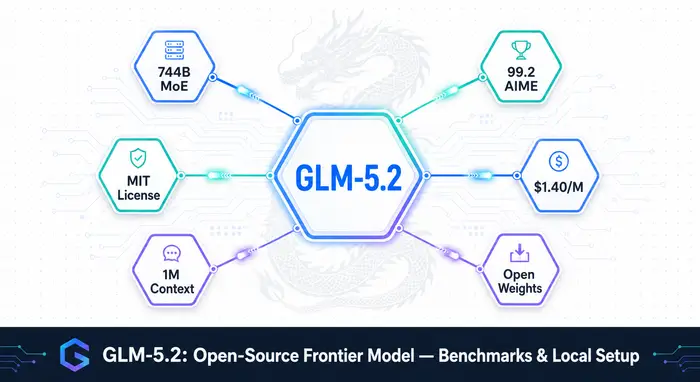
GLM-5.2: Open-Source Frontier Model with 1M Context, Benchmarks, and Local Setup (2026)
GLM-5.2 from Zhipu AI is a 744B open-weight model under MIT license. Benchmarks, pricing, local setup with vLLM and llama.cpp, and how it compares to Claude Opus 4.8 and GPT-5.5.
Models

Kimi K2.7 Code (2026): 1T MoE Coding Model, Benchmarks & Pricing
Kimi K2.7 Code: 1T open-source coding model from Moonshot AI, 32B active MoE, preserve_thinking mode, benchmarks vs GPT-5.5 and Claude Opus.
Models

MiniMax M3 Open Source (2026): 428B Model, 1M Context & Benchmarks
MiniMax M3: 428B open-weights model, 1M context via sparse attention, native multimodal input, competitive coding benchmarks, and 10x cheaper than GPT-5.5.
Models
More stories
View all
US Government Blocks Anthropic Fable 5 & Mythos 5 (2026)
US government ban on Anthropic: Commerce Dept ordered suspension of Fable 5 & Mythos 5 on June 12, 2026. Full timeline of the 4-month feud.
Models

Siri AI Review (2026): Apple's Rebuilt Assistant vs ChatGPT & Gemini [Tested]
Siri AI is Apple's rebuilt assistant for 2026. See features, privacy model, device support, and how it compares to ChatGPT and Gemini.
Review

Claude Fable 5 Release (2026): Anthropic's Most Powerful AI Model Explained
Claude Fable 5 is the first Mythos-class model available to the public. State-of-the-art coding, vision, and knowledge work with new safeguards. Pricing, benchmarks, and what it means.
Models

Ideogram AI Review (2026): Free Tier Tested, vs Midjourney & Recraft
Ideogram AI review (2026): we tested free tier, pricing, text rendering, and Ideogram 4.0 vs Midjourney and Recraft. Who should use it?
Review